Six languages
MoneyTurtle now speaks Español, Português (Brasil), Deutsch, 日本語 and Ελληνικά as well as English. Pick one in Settings and every screen, insight and widget switches at once; amounts keep your region's format.
See Settings →A calm, private expense tracker and budget app for iPhone and Android. Log what you spend, keep an eye on subscriptions, see plain-language insights and follow your net worth over the years — with no accounts, no ads and no tracking of any kind.
Free · No ads · No in-app purchases · iOS 26.5+ · Android 8.0+
Every feature ships on iPhone and Android at the same time, with the same rules and the same wording.
MoneyTurtle now speaks Español, Português (Brasil), Deutsch, 日本語 and Ελληνικά as well as English. Pick one in Settings and every screen, insight and widget switches at once; amounts keep your region's format.
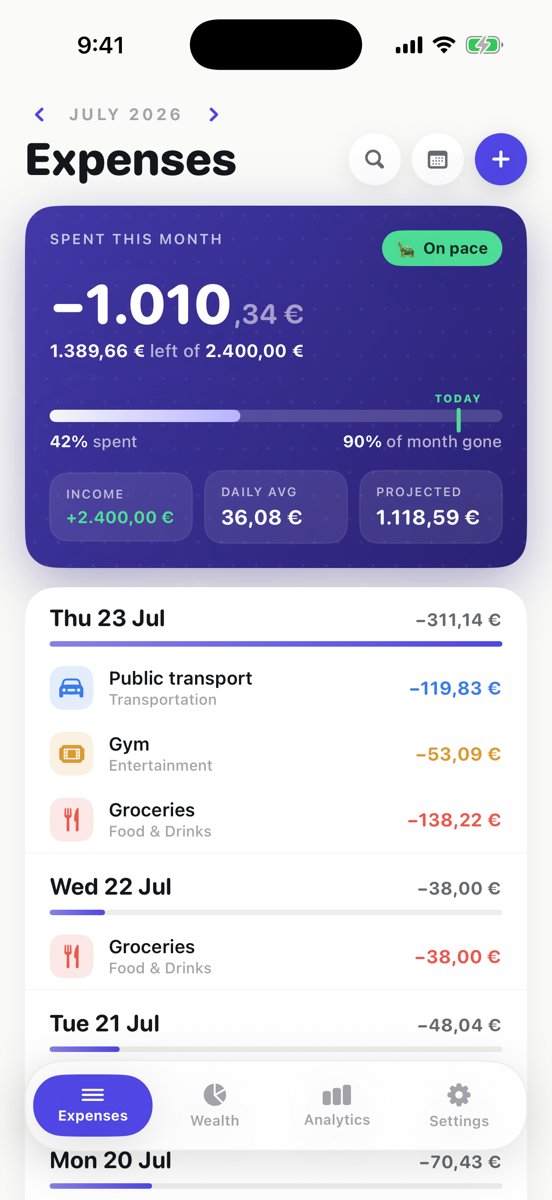
See Settings →What you can spend each day for the rest of the month and still finish within your income — this month's income, minus what you've spent and your subscriptions, divided by the days left. Since 2.16 it sits under Today in the list, so the month's summary stays light. Adding an expense shows where it leaves your day.
See it on Expenses →Step through the months and see what each one really cost: a subscription counts from the month you add it, cancelling keeps the months you paid, and price changes keep their history.
See Subscriptions →A heads-up when one of your top categories runs ahead of your usual pace for this day of the month — measured against your own last six months, so it stays quiet until something is unusual.
See it on Expenses →Up to six plain sentences about your month — savings rate, spending against your average, a net-worth streak — worked out on your phone with plain arithmetic.
See Analytics →Your nest egg measured in years of spending, from Starting to Financial Independence, with thirteen milestones that reward building wealth.
Find your stage →See what investing a fixed amount every month could grow to in Bitcoin, the S&P 500, gold or MSCI World, with live public prices.
Try the calculator →Netflix, the gym, a domain renewal: see what they cost a month and a year and what's due next — and, if you like, log them to Expenses automatically.
See Subscriptions →Split each month's income across your accounts as bars, a ring or a flow diagram, and see what's left to assign at a glance.
See Wealth →Pick a tab — or tap the tab bar on the phone — to see what each screen does.
Add an expense in a couple of taps. MoneyTurtle groups them by day under a budget hero for the month, and a calendar shades each day by how much you spent.
Keep every subscription in one list, ordered by the next charge, with the monthly and yearly cost always in view.
Open Analytics and the first card tells you, in words, what changed this month. No AI and no network: the same data always gives the same sentences.
Track assets and debts month by month, then use the Plan card to split your income and see where steady investing could take you.
Nine accent themes retint the whole app. Tap one on the phone to retint this page too.
The same maths the app uses. Nothing you type here leaves this page.
Dollar-cost averaging — a fixed amount invested at the end of each month, compounding at your expected yearly return.
An illustration with a steady return, not a forecast or financial advice. Markets go down as well as up. In the app, a "10y avg" preset uses ten years of real monthly prices.
Your nest egg — savings, stocks and crypto, not your home — measured in years of spending it covers.
Financial Independence at 25 years follows the 4% rule. The app works this out from the balances and spending you've logged, and adds thirteen milestones.
Written natively for each platform — SwiftUI on iPhone, Jetpack Compose on Android — and every screen exists on both. The JSON export uses the same format on each.
MoneyTurtle collects nothing. There are no servers of ours, no accounts, no analytics and no ads — your expenses, subscriptions, categories and net-worth entries live on your device, and only if you turn it on, in your own private iCloud (iPhone) or Google Drive (Android). The one other request the app makes is the Projection screen's download of public market prices, which carries nothing about you.
Read the full privacy policyYes. MoneyTurtle is free on the App Store and Google Play, with no ads and no in-app purchases.
No. There is no sign-up and there are no MoneyTurtle servers. Your data lives on your phone, and only if you turn it on, in your own private iCloud (iPhone) or your own Google Drive (Android).
No. You add expenses yourself in a couple of taps. MoneyTurtle never asks for bank logins and never sees your bank.
No. Insights such as your savings rate or a net-worth streak are worked out on your phone with plain arithmetic, so the same data always gives the same sentences and nothing leaves your device.
On iPhone, MoneyTurtle can sync between your devices through your own private iCloud. On Android, it can keep a daily backup in the hidden app-data folder of your own Google Drive — it can't see any other file — and restore it on a new phone. Both are optional.
Euro (EUR), US dollar (USD), British pound (GBP), Japanese yen (JPY), Chinese yuan (CNY) and UAE dirham (AED).
English, Español, Português (Brasil), Deutsch, 日本語 and Ελληνικά. MoneyTurtle opens in English; pick another language in Settings → General and every screen, insight and widget switches at once. Amounts keep your region's number format.
A category that is one of the month's top spending categories and is running ahead of what you usually spend on it by this day of the month — 20% by default. MoneyTurtle compares against your own last six months, so it stays quiet until something is unusual. You can change the threshold and how many top categories to watch, or turn it off.
A daily amount under Today on the Expenses tab — this month's income, minus what you've spent and this month's subscriptions, divided by the days left in the month. Today's spending fills a bar against it. Whatever you don't spend today moves to tomorrow, and going over lowers tomorrow's amount. You can turn it off in Settings.
A path on the Wealth tab that measures your nest egg (savings, stocks and crypto) in years of spending it covers: Starting, Building at 1 year, Growing at 5, Compounding at 12 and Financial Independence at 25 years — the 4% rule. Thirteen milestones reward building wealth along the way. Find your stage.
Yes. Everything exports to open JSON at any time, in the same format on iPhone and Android.

Start tracking today — free, private, and on both platforms.